Hair Type Chart: What Are 3B, 3C, 4A, 4B And 4C Hair Types?
What's your hair type? Are you a 3b or 4A hair type? Maybe – that is if you make up one's mind to apply one well-known pilus typing arrangement. Your hair type could also be an "Os" or an "IS" according to a different pilus blazon chart (or system).
Nosotros're asked very oft almost pilus typing systems. More specifically – many naturals are interested in how to determine their hair type.
Mostly speaking – we don't discuss hair typing very often considering there are many things that each person must do to care for their hair regardless of their individual hair type.
Having said that, we do recognize that there are some differences associated with caring for certain types of hair. Furthermore, many women utilise hair typing systems to depict the way their hair looks.
I think it's important to be clear about a few things earlier we begin discussing hair types. There are multiple hair typing systems – including the Andre Walker Pilus Typing Arrangement, LOIS, and FIA's Hair Typing Arrangement.
We don't endorse or recommend whatsoever particular hair typing organization, however, we recognize that the system created by Andre Walker is substantially more than popular well-known, and communicated than the other hair typing systems.
Note: This doesn't imply that Andre Walker's system is necessarily the best or most accurate.
During this guide I will discuss very specific details associated with the most popular hair typing systems – starting time with Andre Walker, then LOIS, and finally FIA.
Disclaimer: Information technology's very easy to incorrectly determine your hair type if y'all only wait at the pictorial representations that accept been provided. Please don't rule out a item pilus type but considering your hair doesn't expect like the pictures beneath.
Table of Contents
- 1 Andre Walker Hair Typing System
- ii Type ane: Straight Hair
- 3 Blazon 2: Wavy Pilus
- iv Type 3: Curly Hair
- 5 Type 4: Kinky Hair
- 6 What's Missing? Now, Let'due south Discuss Pilus Blazon 3C, Type 4C and 4D
- 7 LOIS Hair Typing System (often spelled as 50.O.I.S Hair Typing Organization)
- 8 Pilus Patterns
- nine Hair Strand Sizes
- 10 Hair Textures
- 11 How to Find Your LOIS Hair Blazon
- 12 The NaturallyCurly Pilus Typing Organisation
- 13 Type 2: Wavy Hair
- 14 Blazon 3: Curly Hair
- 15 Type 4: Coily Pilus
- sixteen Fia's Hair Typing System
- 16.1 Related Articles
- 17 Emerging Hair Typing Systems
Andre Walker Hair Typing System

Andre Walker is famously known for creating a hair typing system or infamously known depending on your perspective. Andre reveals his hair typing system in a volume titled Andre Talks Pilus!.
Andre makes it very clear in his book that anybody has expert pilus regardless of ethnicity.
He was hoping to immediately debunk the often ridiculous good hair vs. bad pilus debate prior to diving into a discussion nearly hair typing.
Unfortunately, many people believe that Andre'due south Hair Typing Organisation is hierarchical and intentionally places kinky hair in the bottom ("worst") category.
Andre has made statements over the years that have offended many Type iv women – including the following comment:
Andre Walker on Type iv pilus: "I ever recommend embracing your natural texture. Kinky pilus tin can take express styling options; that'south the only hair type that I advise altering with professional relaxing".
Blazon 4 hair types include the nigh mutual hair types found in black hair.
That statement started a tremendous amount of buzz on the internet. He later issued a statement to clarify his initial comments immediately post-obit the Elle article on his personal website.
Regardless of his original intentions, his comments definitely offended many women.
Even if y'all take a negative opinion of Andre Walker, I encourage you to read the volume yourself and develop your own opinion of his pilus typing system in Andre Talks Hair!.
Andre's system isn't communicated accurately on many popular blogs that have written articles about the system. Having said that, let's hash out the hair types divers in Andre Talks Pilus!.
Blazon 1: Directly Hair

Type one Straight Hair: Generally speaking, Type 1 hair is straight; however, Andre categorizes this pilus type into three very specific segments – Type 1A, Type 1B, and Type 1C.
- Type 1A hair is described as fine, very thin, and soft with a noticeable shine.
- Blazon 1B hair is medium-textured and has more body than Type 1A pilus.
- Blazon 1C pilus is the near resistant to curly styling and relatively coarse compared to other Type i hair types.
Type 2: Wavy Hair
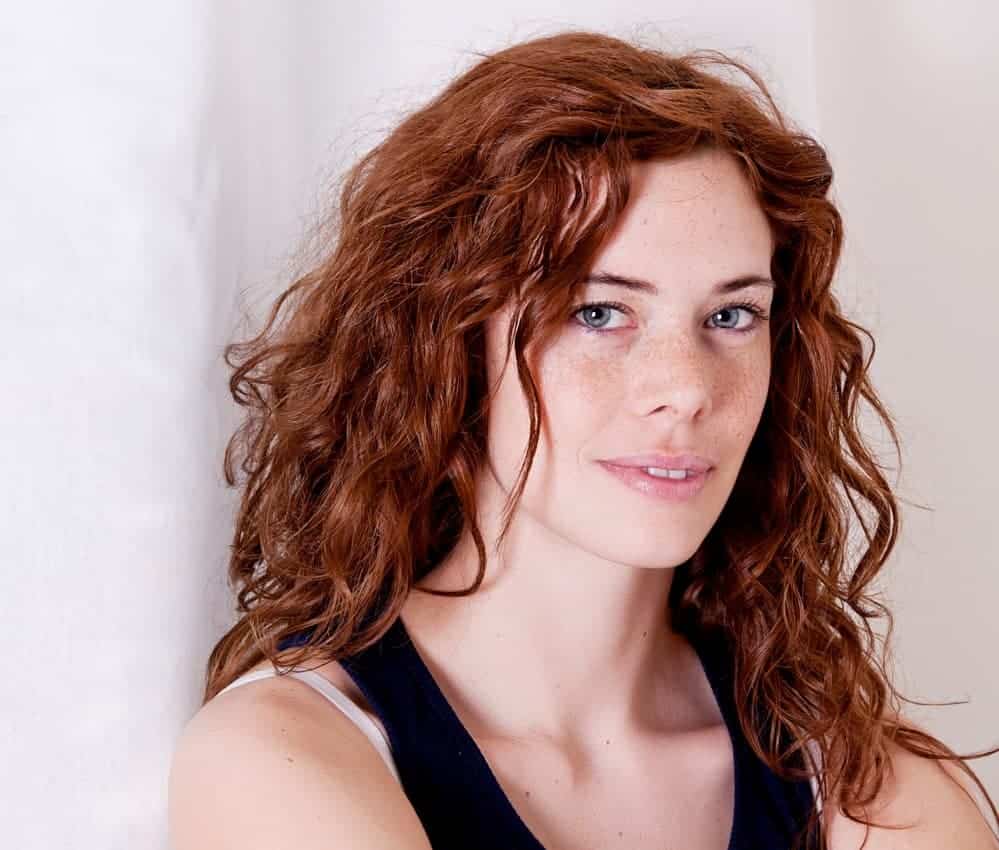
Type ii Wavy Hair: Type 2 is wavy hair that ordinarily isn't overly oily or very dry. The thought is that Type 2 hair falls right in the center of Type 1 and Blazon iii.
- Type 2A pilus is fine and thin. It is relatively easy to handle from a styling perspective because it tin can easily be straightened or curled.
- Type 2B hair characteristically has natural waves that tend to adhere to the shape of your head.
- Type 2C hair will frizz easily, and it is fairly coarse.
Blazon iii: Curly Pilus

Type 3 Curly Hair: Curly hair textures have a definite "S" shaped curl pattern. Since the cuticle doesn't lay flat, y'all volition notice that curly hair isn't near as shiny equally Type 1 (straight hair) or Type 2 (wavy hair) pilus types.
- Type 3A hair is very shiny and loose.
- Type 3B hair has a medium amount of curls, ranging from bouncy ringlets (spiral-like loose curls of hair) to tight corkscrews (spiral-shaped corkscrew curls).
- Blazon 3C hair isn't a role of the Andre Walker Pilus Typing System. Please see the "what's missing" section below for more than information.
Blazon 4: Kinky Hair
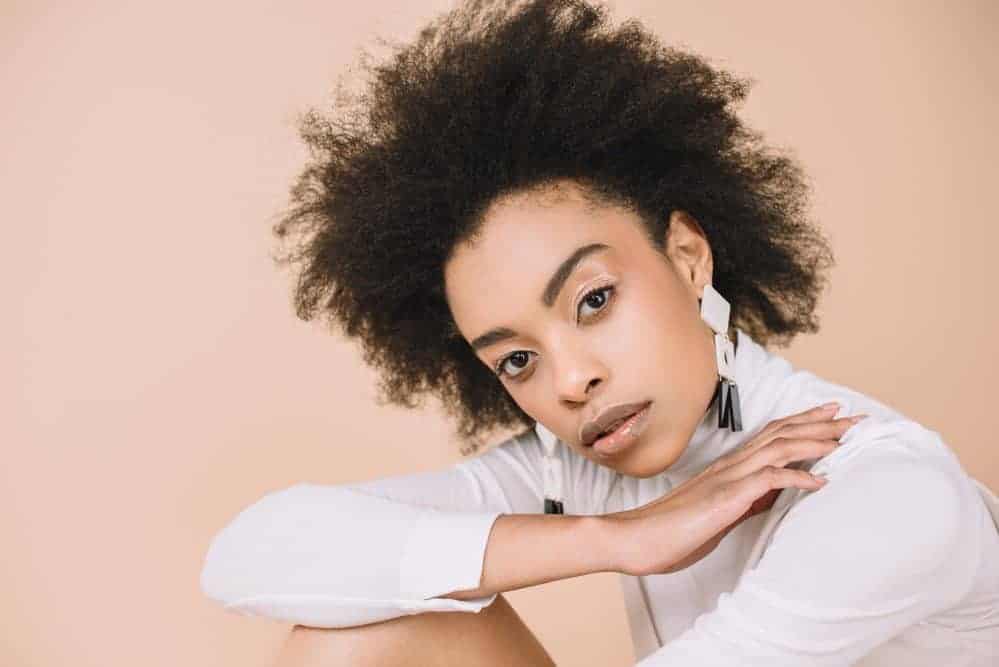
Type 4 Kinky Pilus: Type iv is "kinky" or more than accordingly full of tight coils (tightly curled pilus). Typically, Blazon 4 hair is as well extremely wiry and delicate.
Oftentimes, it appears to be coarse, however, it is really very fine, with several thin hair strands densely packed together. Note that type 4 hair is one of the most common hair types establish in black hair (African American hair).
- Type 4A hair is total of tight coils. It has an "S" pattern when stretched, much like Type 3 curly hair.
- Type 4B hair has a less defined pattern of curls and looks more than similar a "Z" every bit the hair bends with very abrupt angles.
- Type 4C pilus isn't a part of the Andre Walker Hair Typing System. Please see the "what's missing" section below for more information.
- Blazon 4D pilus is an emerging classification. Information technology isn't a office of the original Andre Walker Hair Typing System, although it's become quite popular on social media and hair care forums. More than details are available in the "what'southward missing" section below.
What's Missing? Now, Permit'south Hash out Hair Type 3C, Type 4C and 4D
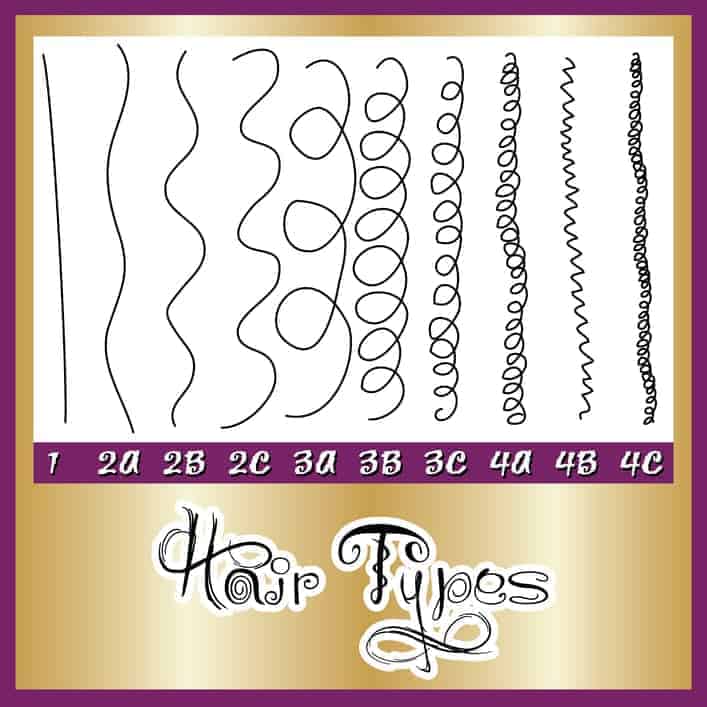
You'll notice that Type 3C, Blazon 4C, and 4D hair types aren't mentioned in the discussion in a higher place, that'due south because they were not included in the original Andre Walker system.
Type 3C was created after Andre Walker released his pilus typing system by a community member at NaturallyCurly.com.
The prevailing thought was that the original hair typing organisation left this pilus type out. Consequently, Type 3C pilus has been divers as tight curls or coils that look similar corkscrews.
Type 4C, like Type 3C, isn't an bodily pilus type according to Andre Walker's Pilus System.
His comments are actually very simple regarding Type 4 (Kinky) hair – if you can come across a definite curl pattern, and then you have Type 4A hair. If yous tin't identify a defined, specific roll blueprint, then your pilus type is 4B.
I would imagine that the Type 4C hair type was created by a fellow member within the natural pilus community – only like the Blazon 3C hair type.
Similarly, the 4D hair type was created within the natural pilus customs. It's very popular on social media and hair care forums. Information technology's unremarkably described as a more tightly coiled "extension" of the 4C hair type.
LOIS Hair Typing Organization (frequently spelled as L.O.I.S Hair Typing Organization)

The LOIS Hair Typing organization appears to be dying a slow expiry, although there are many naturals that advocate for information technology over the more well-known Andre Walker Hair Typing Arrangement.
LOIS was created past a website that is no longer active. The hair typing is considered by many to be very user-friendly – due to its simplicity.
The LOIS pilus typing system defines hair using three characteristics: (1) pattern, (two) strand size, and (three) texture.
Hair Patterns
The LOIS organisation defines the hair pattern by the messages LOIS. I'll explain:
- Fifty = If your hair is dominated by correct angles and essentially bends with near no curve, then y'all're considered a design "50".
- O = If your hair strand curls or coils significantly and appear to be shaped like the letter "O", so you're considered a pattern "O".
- I = If your hair has no distinctive curls or bends and primarily lies flat against your head, and so you're considered a design "I".
- Southward = If your hair strand has "S" shaped curls or gorgeous waves with defined hills and valleys, and so you're considered a pattern "S".
Finally, it's important to note that you may have several different LOIS hair patterns on your head. When this occurs, the system allows you to combine LOIS letters to determine your hair pattern.
For example, your hair pattern may be an "OS" LOIS pilus type. In this case, your hair would incorporate primarily a combination of "O" shaped spiral curls and "Southward" shaped curly waves with defined hills and valleys.
Hair Strand Sizes
Identifying your hair strand within the LOIS arrangement starts with using a strand of frayed thread. 1 piece of a frayed thread (like a slice of sewing thread) is used as a proxy to determine the size of your pilus strand.
The full general thought (according to the LOIS hair typing system) is that a piece of thread is approximately the size of a medium-sized strand of hair.
- Smaller than a piece of sewing thread = Thin, fine hair strands
- Size of a piece of sewing thread = Medium hair strands
- Larger than a piece of sewing thread = Think pilus strands
Pilus Textures
- Thready – This thready hair texture has a low sheen and a vivid smoothen when the pilus is stretched. This hair texture should have low frizz and get wet easily. Even though this hair texture wets easily, the water volition dry out very speedily.
- Wiry – This pilus texture sparkly sleeky advent with very fiddling smoothen and low frizz. When the wiry hair texture is wet, the water will bead up or bounce off the hair strands. This pilus texture is more difficult to go fully wet.
- Cottony – The cottony pilus texture has a low sheen, a bright smoothen when the pilus is stretched and is usually is highly frizzy. The cottony texture absorbs water very quickly; notwithstanding, information technology doesn't get completely wet very fast.
- Spongy – The spongy pilus texture absorbs water (like a sponge) and has a high sheen and low shine.
- Silky – The silky texture has a low sheen and a bright high shine. The level of expected frizz with this hair texture can vary substantially. Silky hair becomes completely wet very easily.
How to Observe Your LOIS Pilus Blazon
Examine a few of the most common types of pilus on your caput. If you have multiple pilus types within the LOIS system, then y'all should begin by examining the most common pilus type of your head.
Prior to examining your hair, be sure that it has been recently washed (rinsed in common cold water) and doesn't have any hair products applied to it.
Another option is to launder a strand of hair that has been removed from the scalp and rinse it in cold water. Allow the individual hair strand to dry out without touching it to get an accurate depiction of the LOIS hair type.
The NaturallyCurly Hair Typing System

1 new hair typing organisation that has grown in popularity amidst women with curly hair types is a modified version of the Andre Walker system recommended by TextureMedia, which owns the brands and web properties of NaturallyCurly and CurlyNikki.
According to NatuallyCurly, your pilus type is the fundamental to determining the right products and hairstyles of your hair. This hair typing system focuses on three types of hair: Wavy, Curly, and Coily.
The NaturallyCurly system farther classifies the three aforementioned categories into sub-classes: A to C.
These subclassifications, which are based on the diameter of the hair's wave, curl, or scroll, are borrowed straight from the original Andre Walker hair typing system.
As per usual, the goal of this hair typing organisation is to clear up the confusion and then women can comprehend their naturally curly hair and observe the all-time hair products for their hair.
The reality is that many women don't fit perfectly into one category and subclassification. It'south mutual to have a combination of pilus types (or different types of curls) on your head.
Type two: Wavy Pilus
Type 2 hair has a wavy texture. It's not quite straight, yet information technology's not fully curly. It'southward a spectrum that ranges from thick, Southward-shaped waves mixed with curls to loose loops.
The type 2 texture tends to be flatter around the root which makes it lay close to the head. It gets curlier from effectually the ears down.
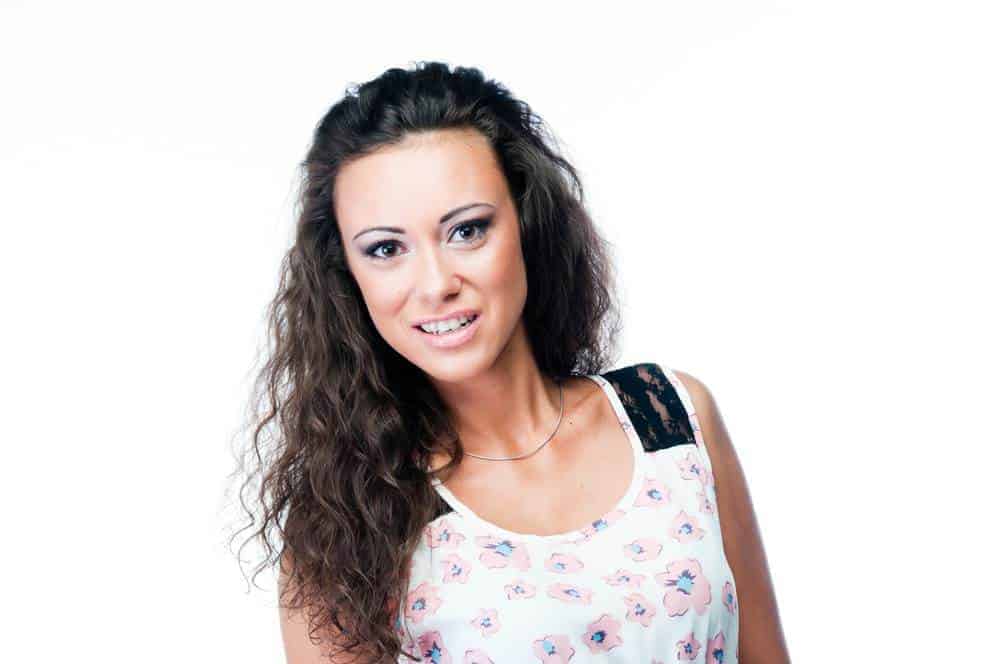
Type 2A: Your waves have a tousled, loose pilus texture. Due to the lack of definition and volume, pilus products can hands weigh downward your strands. If you desire to maintain your curls then use lighter hair products such as gels and mousses.

Type 2B: Your hair is directly at the roots, at least for the near office, and has S-shaped waves that have more definition from the mid-length downwardly to the ends. The texture is medium and has a bit of frizz at the crown. If you want more definition equally a 2B hair type, plop your hair when it'due south freshly washed.

Type 2C: Your waves are much more defined and start all the way at the roots with ringlets and curls. The texture is generally coarse or thick, which has a addiction of frizzing. Diffuse your hair while information technology's wet, although your pilus should not exist soaking wet if you want more than book.
Type 3: Curly Pilus
Type 3 pilus ranges from tight, curly tendrils to lite curls. It by and large has a combination of dissimilar textures. Type iii hair types are also divers as springy curls. They have more volume as well equally height at the roots than blazon 2 hair types, which are wavy.

Type 3A: Your curls are big and loose. If y'all've e'er seen sidewalk chalk and then you accept a good gauge for the circumference of Type 3A curls.
They tend to be shiny too and are S-shaped. If y'all desire more ringlet definition, try to twirl tiny sections of curls effectually your finger when your hair is damp.
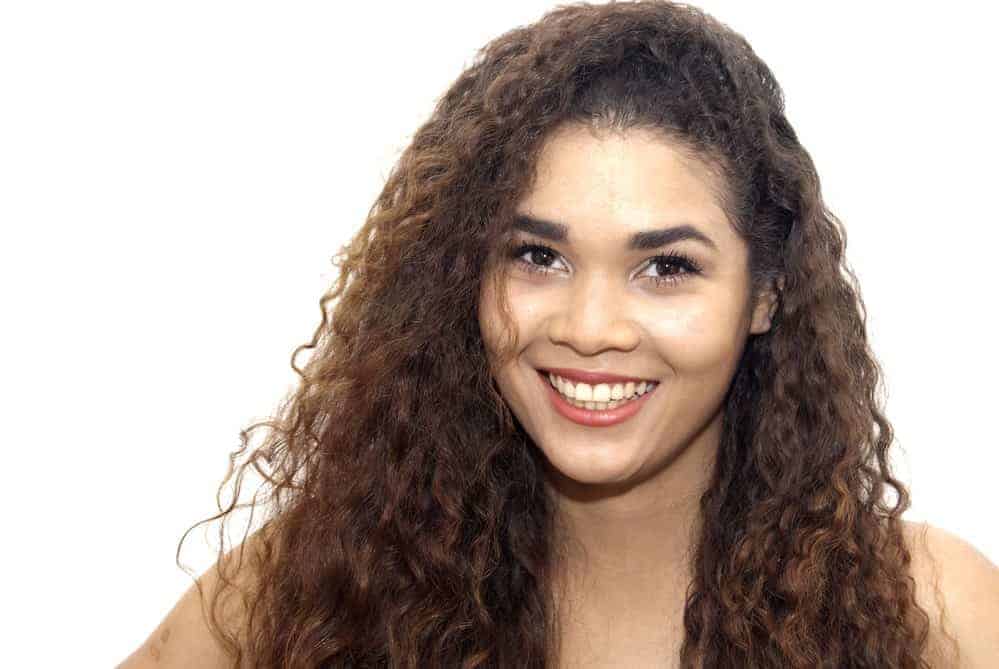
Type 3B: Your curls are springy, and you can observe variants anywhere from corkscrews to ringlets. Your curls are also voluminous.
Where 3A pilus types take curls that are approximately the circumference of sidewalk chalk, 3B hair types are comparable to a permanent marker.
3B pilus is generally dense. Use humidity-blocking styling products. You might want to use styling milk if you want more definition but less frizz.
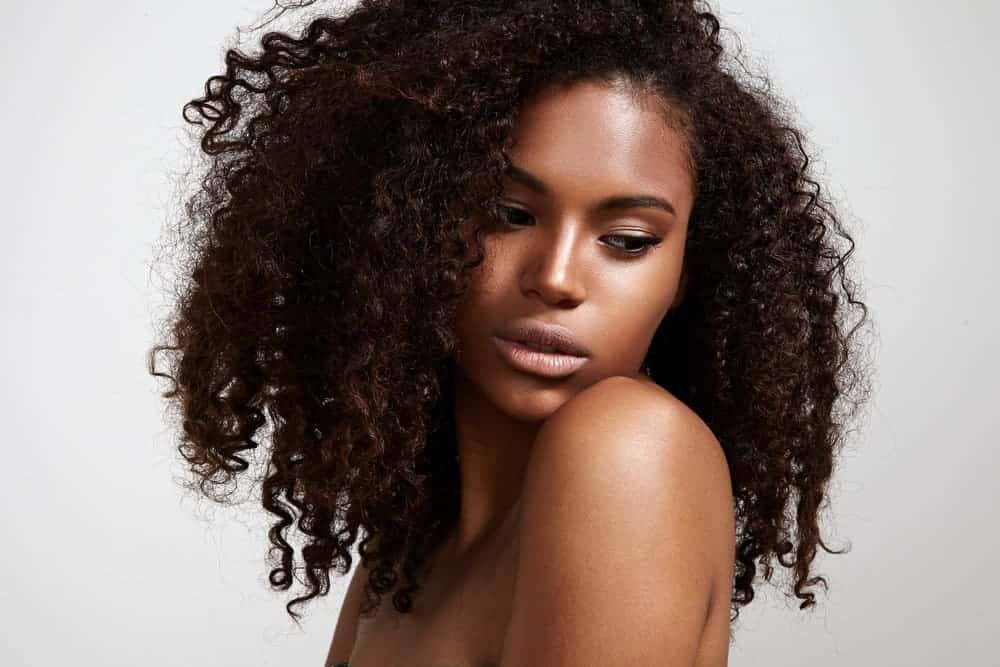
Type 3C: This is sometimes chosen "curly-coily" pilus due to its density. It's made upwards of tightly packed corkscrew-similar curls that tend to exist as big around as a pencil.
3C tends to have the highest amount of book, but besides tends to take the most shrinkage. Stretch and raise gently without heat with a flexi-rod ready, twist-out, or a set up of perm rods.
Type 4: Coily Hair
Coily hair is sparse and fine, or wiry and coarse, and has coils that are densely packed. People often think coily hair is robust, merely that is not the case!
It's the nearly fragile texture due to having the fewest cuticle layers protecting it from dryness. The top pilus concerns with type 4 hair are avoiding tangles, maintaining moisture, and fighting off shrinkage.

Blazon 4A: Your coils are either fine or wiry with the circumference of a crochet needle. They're even so dense and springy with a notable S design.
Use natural emollients with a thicker consistency, such as shea butter to become the most out of your twist-outs or wash-and-go styles subsequently you wash.

Type 4B: Instead of coiling or curling, you have pilus that bends in sharp angles. They expect quite a bit like the letter Z. The ringlet is tighter and far less defined, having the circumference of an ink pen.
The strands range from wiry and coarse to fine and thin. Pre-poo using kokosnoot oil to retain your scalp's natural chemistry.
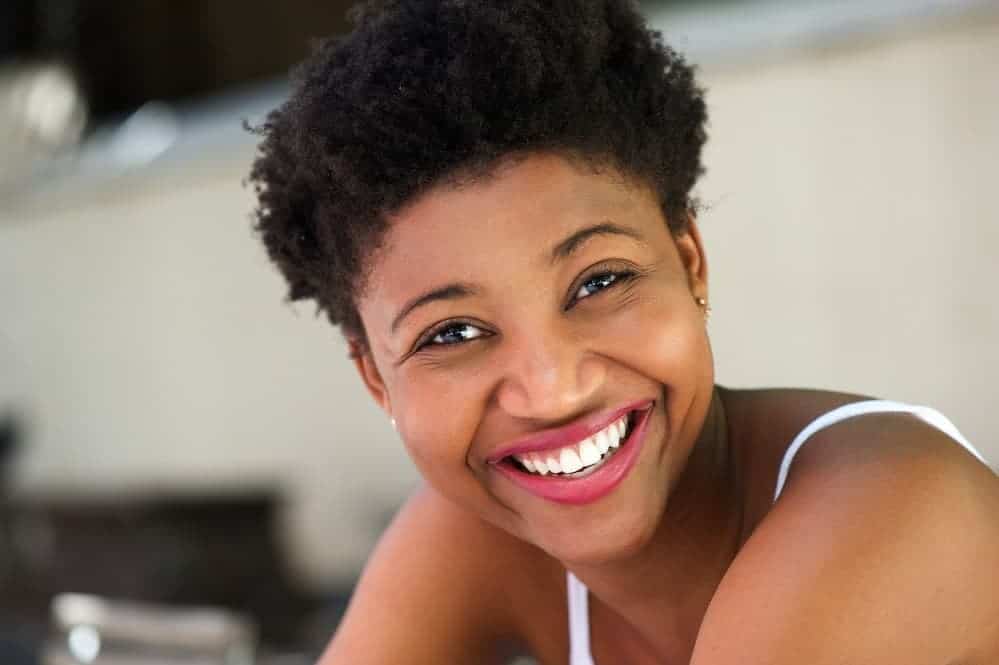
Blazon 4C: Y'all have hair every bit densely packed as 4B, just with less definition as well as more shrinkage. The hair texture, which is tightly coiled like all Blazon 4s, ranges from super fine and soft to coarse and wiry. It's incredibly delicate hair. Try using a humectant with a creamy consistency equally a go out-in product.
Fia's Pilus Typing Organisation

There is 1 other pilus typing system that had a consequent following several years ago. Actually, in that location are however several women on some natural hair forums that are advocates for Fia's Hair Typing Organization.
Fia's Hair Typing Organization appears to expand on Andre Walker's Pilus Typing System and incorporate components of the LOIS Pilus Typing System also.
The system defines hair using 3 classifiers: (ane) the definition of your curls (think Andre Walker), (two) the appearance of near of your hair strands, and (3) the overall book of your hair.
First Classifier: The first classifier which defines your natural pilus type by determining the curliness of your hair strands (or the lack thereof – if that'south the instance) is analogous to Andre Walker system utilizing Blazon 1 – straight hair, Type 2 – wavy hair, Type 3 – curly pilus and Type iv – actually curly hair.
2nd Classifier: The second classifier focuses on the appearance of the majority of your hair strands. Really, this classifier is very like to the pilus strand sizes used inside the LOIS system, but in that location are some pocket-sized differences in terminology.
- F – Fine: Fine, thin hair strands that feels almost like an ultra-fine strand of silk.
- M – Medium: Medium sized pilus strands, which by and large feel similar rolling a cotton thread between your thumb and alphabetize fingers, are ones that simply fall in between the fine and coarse categories according to Fia's Hair Typing Arrangement.
- C – Fibroid: Think hair strands that feel difficult and wiry.
Third Classifier: The 3rd classification of Fia's Hair Typing Organization measures the overall volume of your hair. Simply place your hair in a ponytail.
Include as much hair as possible in the ponytail. There is no demand to worry likewise much near how your hair looks because the goal is to have the majority of your pilus included in the ponytail.
In one case you have the bulk of your pilus in a ponytail, the next stride is to measure the circumference of the ponytail.
You lot tin use a soft tape measure or another method that won't damage your hair to measure the circumference of your ponytail.
Simply wrap the soft tape measure effectually your ponytail below the elastic (ex. Goody Ouchless Pilus Elastics) used to concord the ponytail together.
The number shown on the soft record mensurate is used to determine whether your hair fits into the thin, normal, or thick co-ordinate to Fia'due south Pilus Typing System.
- Thin – The circumference of the ponytail is less than 2 inches (less than v centimeters)
- Normal – The circumference of the ponytail is between ii – 4 inches (between v-10 centimeters)
- Thick – The circumference of the ponytail is greater than four inches (greater than 10 centimeters)
Note: The circumference is just the measured distance around a circumvolve or edge of an object that is roughly circular.
- Do I Take 2c or 3a Hair?
- 4D Hair
- How to Care For Coily Pilus
Emerging Hair Typing Systems
There are other emerging curl-type systems, but honestly, virtually of the new ones aren't well known.
If these emerging systems achieve an adequate social following, and then I will update this article to include a complete discussion of those hair typing systems.
At the moment, any pilus typing system that doesn't have a legitimate following within the curly community (or natural hair community) is considered outside of the telescopic of this guide.
Lately, many hair production manufacturers are creating proprietary hair typing systems in club to sell more than hair products to individuals looking for personalization in their natural hair regimen.
That said, several manufacturers have created product guides based on the very well-known Andre Walker Pilus Typing Organization to recommend their products on a personalized basis.
Source: https://www.curlcentric.com/hair-typing-system/
0 Response to "Hair Type Chart: What Are 3B, 3C, 4A, 4B And 4C Hair Types?"
Publicar un comentario